Maker - MK whistles (Misha Somerville) http://jazzwhistle.com
Material - Aluminum and Brass
Dimensions: Length - 19"
Distance between 1st and 3rd bottom holes - 2 9/16ths"
Diameter of 2nd hole from bottom - 7/16ths"
Bore - 6/8ths"
Weight - 5.5 oz
Price at time of review - 150 lbs direct from Maker
When
I first started researching all the different brands of Low whistles
available, a few makers' names naturally floated to the top; Overton,
Burke, Chieftain, Copeland. But occasionally someone would mention the
mysterious "MK". Sort of a white whale of whistles, everyone had heard
of them, everyone said they were great, but few people had them and the
waiting list was huge. Not to be daunted, I shot off an email to far
Scotland, and was indeed informed that the waiting list for a Low D
ranged from 6-12 months. I dutifully got in line and tried to put it
from my mind. Then I caught a rumor that someone who new someone whose
cousin had a brother who was the bouzouki player for some Irish band
whose whistle player said that Misha said that there may be some Low
F's available soon, so I emailed back and sure enough, I was told I may
be lucky enough to obtain a low F in just a few short weeks! You can
imagine my excitement when I received the tube from Scotland, and then
my subsequent disappointment when the first thing I noticed upon
pulling the whistle from it's very nice padded bag (black corduroy with
Velcro closure) was a small but visible dent on the top of the head
joint. Off shot another email to Scotland, and I was assured that I
could return the whistle for a refund or replacement. Having surmised
in the mean time that the only thing I did not like about the whistle
was the dent, I opted for the replacement. A few weeks later I was
holding the whistle that is reviewed here.
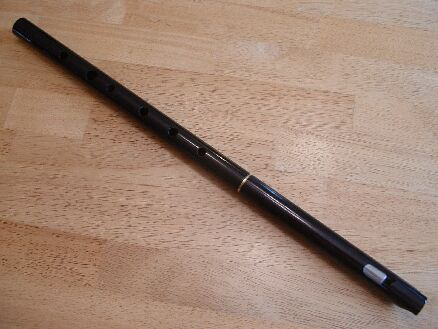
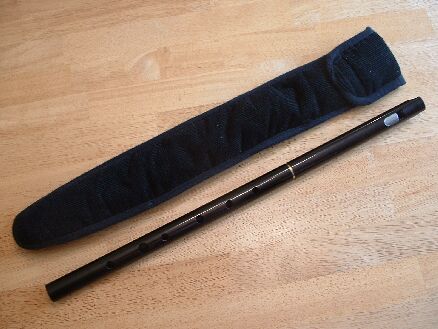
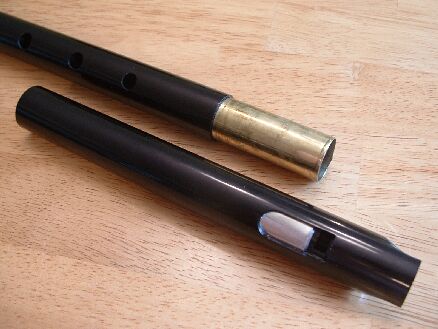
Appearance:
At first glance, words like "slick" and "professional" come to
mind when looking at this whistle. It somehow manages to avoid the
"pipe with holes in it" look while still being, well, a pipe with holes
in it. One of the big reasons for this is the glossy anodized
finish, which I found to be reminiscent of the gloss paint
jobs/finishes you see on cars. This finish gives the somewhat false
impression that the whistle would be slippery to hold, but I found that
as long as my hands were dry, it actually had a nice grip to the
surface, especially when compared to nickeled whistle bodies. The
contrast of the silver blade and brass tuning slide looks striking
against the gloss black of the body (MKs are currently available in
black, red and green finishes). Indeed, pictures just don't do this
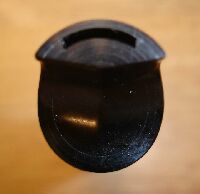
whistle justice. The mouthpiece is oddly carved with a ridge running
down the middle of the underside. It looked like it would be
uncomfortable, but I did not find it to be so. It actually facilitated
playing the whistle out of the side of ones mouth, but worked just fine
using the standard, straight on position as well. MK's really stand out
from other brands as being very attractive, good-looking whistles.
Tone: This instrument has a tone that just says Irish whistle, with an excellent blend of breathiness and chiff mixed with a strong and complex tone. It is noticeably breathy, and I'm begining to wonder if this may be due to the construction of the blade and fipple window. The Chieftain V3 has a similar construction and I found it to be very breathy. Another whistle with the same style of window is the Alba Vibe, and I look forward to trying one to confirm my theory. Unlike the V3, whose tone seemed to me to be buried under allot of air/breath noise, the MK sounds more like the breathiness blends with or sits evenly next to the purer aspect of it's tone, rather than being two competing sides. I would say that the whistle has a moderate amount of chiff. The tone was well balanced between octaves, with a nice solid low end up into a slightly purer high end.
Volume: I would describe the volume of this whistle as being moderate to loud. It is fairly well balanced between octaves, and would likely have no problem being heard in most session environments.
Backpressure/air requirement:This whistle has little to no backpressure to speak of. However, given its smaller size, I did not find myself running out of breath too quickly as compared to a Low D. The only issue I did have is that the second octave High D note required more air/breath support to keep if from breaking than I would prefer. Oddly, I did not have this problem with the first MK low F that I had received and returned.
Responsiveness: This whistle is incredibly responsive, with cuts and rolls virtually exploding under your fingertips. I did not find the whistle to be overly fussy and the notes did not tend to break to easily, with the exception of the aforementioned High D.
Clogging: I did not experience any clogging issues with this whistle, however, fluid occasionally had a tendency to collect on top of the blade after prolonged play.
Tuning: This was the most in tune whistle I have ever played! All notes were either spot on or at least within 5 cents of true. Unfortunately, the E flat has to be payed as OXXXOO instead of the usual OXXOOO, but it is perfectly in tune with three fingers down.
Sound clip: South Wind
Summary: I really, really, liked this whistle. The issue with the High D note and the E flat fingering were the only things that kept me from giving it six holes. Why then, you may ask, did I subsequently sell it? Bottom line is that I just prefer Low D's. I didn't think that I would personally play this F enough to justify its comparatively hefty price tag. Not that I think that the whistle is not worth it!, Quite the contrary, I found it to be a well crafted work of art worth every cent. But I just couldn't stop thinking about all the Low D's I had yet to try! Needless to say, I cannot Wait to get an MK Low D. Only four or five months to go! I hope.
Update: I actually missed this whistle so much I bought another one!, Still waiting for a Low D though...


Tone: This instrument has a tone that just says Irish whistle, with an excellent blend of breathiness and chiff mixed with a strong and complex tone. It is noticeably breathy, and I'm begining to wonder if this may be due to the construction of the blade and fipple window. The Chieftain V3 has a similar construction and I found it to be very breathy. Another whistle with the same style of window is the Alba Vibe, and I look forward to trying one to confirm my theory. Unlike the V3, whose tone seemed to me to be buried under allot of air/breath noise, the MK sounds more like the breathiness blends with or sits evenly next to the purer aspect of it's tone, rather than being two competing sides. I would say that the whistle has a moderate amount of chiff. The tone was well balanced between octaves, with a nice solid low end up into a slightly purer high end.
Volume: I would describe the volume of this whistle as being moderate to loud. It is fairly well balanced between octaves, and would likely have no problem being heard in most session environments.
Backpressure/air requirement:This whistle has little to no backpressure to speak of. However, given its smaller size, I did not find myself running out of breath too quickly as compared to a Low D. The only issue I did have is that the second octave High D note required more air/breath support to keep if from breaking than I would prefer. Oddly, I did not have this problem with the first MK low F that I had received and returned.
Responsiveness: This whistle is incredibly responsive, with cuts and rolls virtually exploding under your fingertips. I did not find the whistle to be overly fussy and the notes did not tend to break to easily, with the exception of the aforementioned High D.
Clogging: I did not experience any clogging issues with this whistle, however, fluid occasionally had a tendency to collect on top of the blade after prolonged play.
Tuning: This was the most in tune whistle I have ever played! All notes were either spot on or at least within 5 cents of true. Unfortunately, the E flat has to be payed as OXXXOO instead of the usual OXXOOO, but it is perfectly in tune with three fingers down.
Sound clip: South Wind
Summary: I really, really, liked this whistle. The issue with the High D note and the E flat fingering were the only things that kept me from giving it six holes. Why then, you may ask, did I subsequently sell it? Bottom line is that I just prefer Low D's. I didn't think that I would personally play this F enough to justify its comparatively hefty price tag. Not that I think that the whistle is not worth it!, Quite the contrary, I found it to be a well crafted work of art worth every cent. But I just couldn't stop thinking about all the Low D's I had yet to try! Needless to say, I cannot Wait to get an MK Low D. Only four or five months to go! I hope.
Update: I actually missed this whistle so much I bought another one!, Still waiting for a Low D though...